
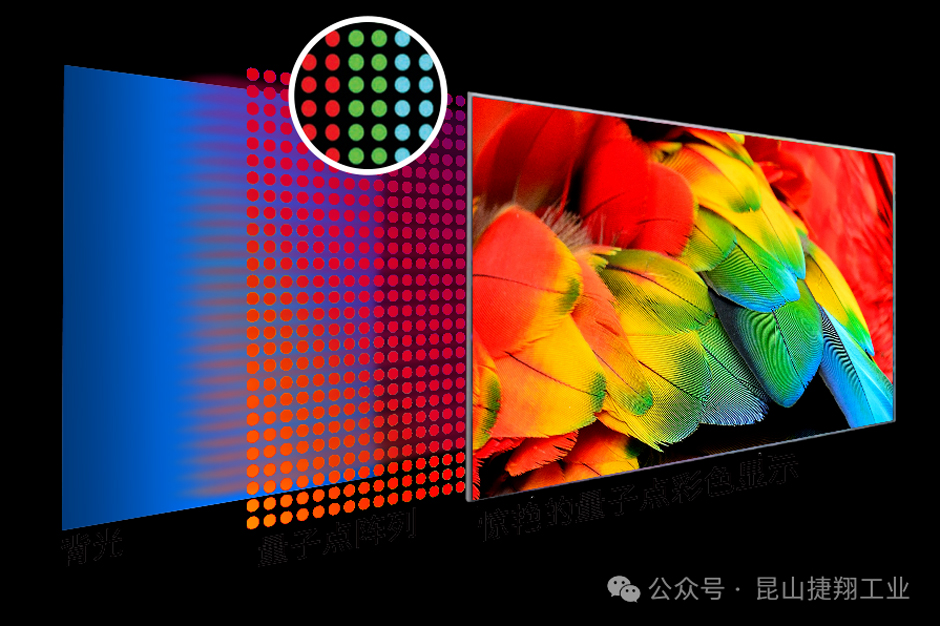
The screens we view daily on phones, computers and TVs look smooth and sharp, but they undergo rigorous quality checks before shipment. As the most widely used display technology, LCD covers upstream polarizer and substrate fabrication, midstream module lamination, and downstream finished-product inspection. Tiny flaws at any stage may degrade visual experience and shorten product service life. At the heart of this quality assurance battle lies machine vision inspection. Using machines as eyes and algorithms as brains, it overcomes the limitations of traditional manual visual inspection. With accurate, efficient and stable detection capabilities, it serves as the “invisible guardian” for high-quality development in the LCD industry. Today we will uncover the indispensable role of machine vision inspection within the LCD sector.
LCD manufacturing is an extremely sophisticated process. Up to a dozen layers including TFT substrates, liquid crystal layers, color filters and polarizers require precise lamination. Defects may emerge at every production stage. More importantly, with technological advances, LCD panels have reached 4K and 8K resolutions. A 6.7-inch screen contains over 10 million pixels. Even a defect rate of one in ten thousand can result in non-conforming batches. Traditional manual inspection can no longer keep pace with industrial development. The human eye cannot distinguish nano-scale micro scratches; inspectors suffer fatigue after long working hours, leading to high missed-detection rates. Subjective judgment also varies between individuals, making uniform inspection standards impossible. Featuring non-contact, high-precision and high-speed strengths, machine vision inspection perfectly addresses these pain points. It captures microscopic defects invisible to human eyes, enables 24/7 continuous inspection, and digitizes and traces inspection criteria. It serves as core support for the automation and intelligent upgrading of the LCD industry.
Core Application Scenarios of Machine Vision in the LCD Industry
Machine vision inspection works not only at the final finished-panel stage. It runs through the entire workflow from upstream raw materials to downstream finished goods delivery, playing its part at every stage to accurately intercept various types of defects.
The core raw materials for LCD panels include polarizers, glass substrates and color filters. Their quality directly determines the final display performance of screens, and machine vision inspection stands guard right from this stage. Take polarizer inspection for example. As the “optical filter” of LCD panels, scratches, stains, bubbles or dimensional deviations on its surface will impair light transmittance and display uniformity. Equipped with high-frame-rate line-scan cameras and custom telecentric lenses, the machine vision system delivers high-precision inspection of ±0.08 mm under high-speed transport up to 36 km/s. It accurately identifies micro defects larger than 0.1 mm² while performing dimension measurement and positioning, supplying precise data for subsequent lamination processes. For glass substrate inspection, the vision system uses dedicated light illumination to rapidly detect pinholes, burrs, dents and other surface defects. It prevents flawed substrates from moving to downstream processes and cuts production costs at the source.
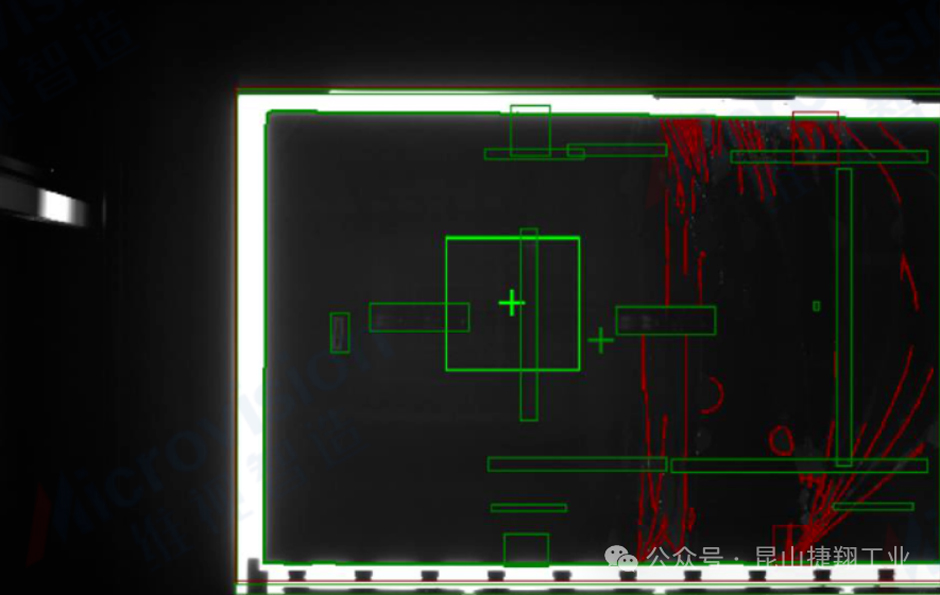
Midstream LCD manufacturing is where defects most frequently occur, covering liquid crystal filling, substrate lamination and circuit etching. Machine vision inspection undertakes full-process monitoring here, mainly intercepting three core types of defects. First, liquid crystal filling inspection. Liquid crystal uniformity directly affects display consistency. Uneven filling causes Mura defects with local graying and color distortion on panels. Such defects feature blurred edges and are hard for human eyes to identify accurately. With image preprocessing, background suppression and defect segmentation algorithms, machine vision reliably captures these low-contrast subtle blemishes, and also detects bubbles or missing filling. Second, substrate lamination inspection. Ultra-high alignment precision is required for upper and lower substrates. Minor misalignment leads to display offset, bright lines or dark lines. Using image registration technology, the vision system compares substrate alignment marks in real time, measures offset precisely to maintain micron-level lamination accuracy, and checks for scratches or foreign residues generated during lamination. Third, circuit etching inspection. Circuits on LCD panels are as fine as hair. Broken circuits, short circuits or burrs from etching may trigger abnormal display or total panel failure. High-resolution cameras capture circuit images, and deep learning algorithms rapidly spot tiny circuit defects. This method boosts inspection efficiency by over 10 times versus manual inspection, with an accuracy rate above 99.9%.
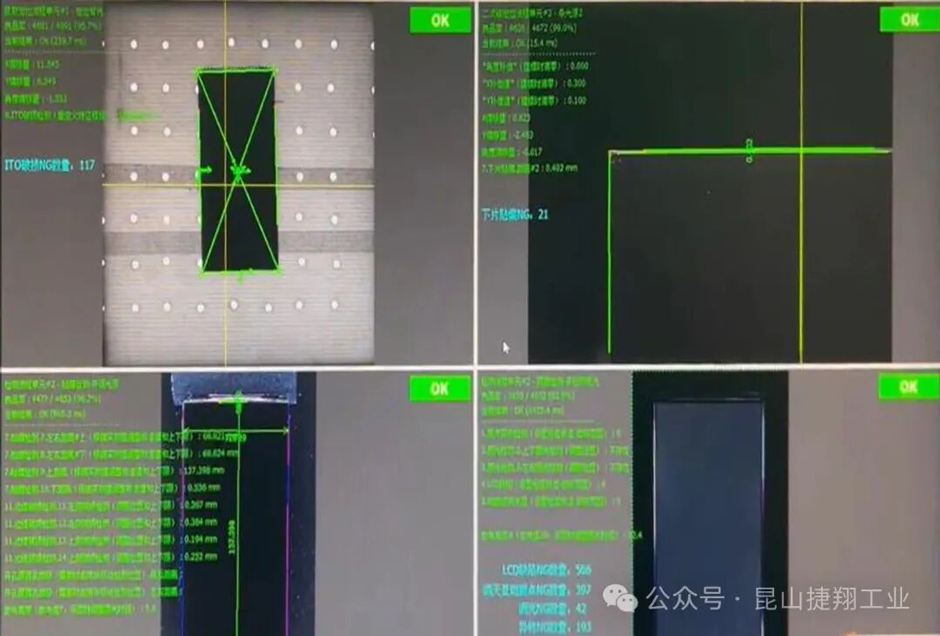
After all manufacturing processes are completed, finished LCD panels undergo a comprehensive visual inspection, acting as a full health check to guarantee every panel released to the market meets quality criteria. It mainly targets two categories of core defects. The first category covers pixel-level defects: bright dots, dark dots and dead pixels. A bright dot refers to a pixel that stays lit on a black screen; a dark dot is a pixel that remains unlit on a white screen; a dead pixel means all red, green and blue sub-pixels are damaged. By switching among white, black, red, green and blue test patterns, the vision system rapidly scans every pixel to pinpoint these tiny defects barely detectable by human eyes and strictly limits the count of pixel defects to comply with industry standards. The second category includes cosmetic and display defects: scratches, stains and bumps on the panel surface, together with mura, brightness deviation and image retention during display. Besides, finished-product inspection also uses vision technology to verify performance indicators such as viewing angle and response speed, ensuring optimal display performance under diverse application scenarios.

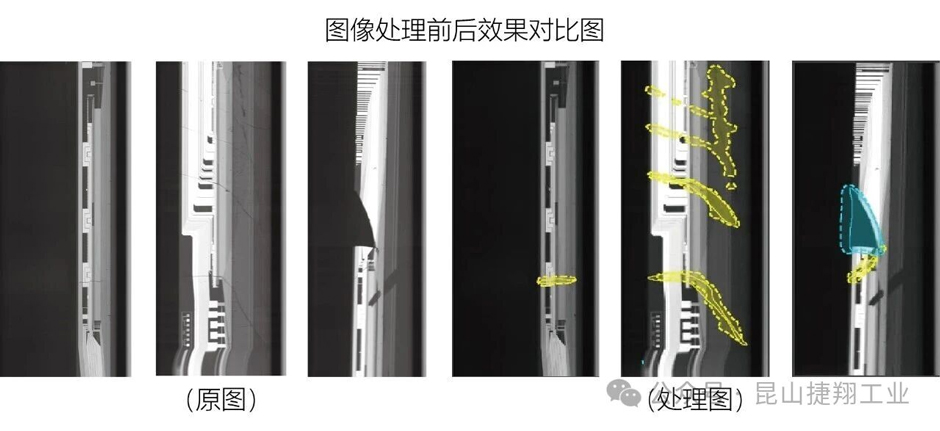
As the LCD industry advances toward higher resolution, higher refresh rates and flexibility, machine vision inspection technology keeps evolving from early rule-driven frameworks to data-driven ones, becoming smarter and more efficient. Early vision inspection relied heavily on manually configured inspection rules, which tended to cause false positives and missed detections for defects varying with environmental conditions. Today’s deep-learning-powered vision inspection is trained with massive defect samples to learn defect features autonomously. It can accurately identify known defects and capture unknown ones. Combined with physical modeling, it traces back the root process causes of defects, supplying data support for production optimization and forming closed-loop management of “detection – analysis – optimization”. For example,The AI vision quality inspection system for Longteng screen crack detection solution can accurately identify defects such as bright spots, dark lines and water ripples. By repeatedly learning from good samples, it efficiently distinguishes unknown defects. It cuts labor costs directly by 50% and boosts inspection efficiency and accuracy by over 30%.
Jiexiang delivers targeted precision inspection for critical vulnerable zones of LCD panels. It fully covers edge cracks on Source and Gate sides, as well as package cracks and micro damages within IC, FFC and COF bonding regions. Jiexiang industrial inspection boasts outstanding precision: it can detect cracks as tiny as 5 μm in width and 300 μm in length. The cycle time per piece is stably controlled within ≤10s, with pixel precision up to 0.0017 mm/pixel, perfectly suited for mass-production lines.
The equipment adopts a dual-vision architecture consisting of MV-CS050-10GM area-scan camera and PL8KCL line-scan camera, paired with customized optical components. Equipped with dark-box light shielding and whole-machine vibration damping design, it effectively isolates external light interference and vibration. Fully automatic closed-loop operation runs from material loading to unloading. Powered by AI vision and deep learning algorithms, the solution greatly reduces missed and false detections. Its stable 10s cycle time seamlessly connects to production lines, cuts costs for manual inspection and re-judgment, and supports fast product model switching. All inspection data is recorded and traceable throughout the process, fully guaranteeing accuracy and efficiency for screen crack inspection.
As a core segment of China’s new display industry, LCD panels derive their core competitive edge directly from product quality. Machine vision inspection serves as a vital pillar for this quality assurance. It replaces the limitations of human inspection with mechanical precision, boosts inspection efficiency via intelligent algorithms, and catches every tiny defect through full-process monitoring. From small polarizer sheets to the phone and TV screens we use daily, every flawless LCD panel is quietly guarded by machine vision inspection. With continuous technological breakthroughs, it will adapt to inspection demands for emerging display technologies such as flexible LCD and Mini LED, further fueling high-quality growth of the LCD industry and delivering sharper, more perfect visual experiences.